The Goal of Investor Relations (IR) and My Strategic Approach to IR
Over the years, I've heard different perspectives from CEOs, CFOs, and IROs on what the goal of investor relations is. These include: selling the company's stock (like a salesman sells a product), increasing financial transparency, meeting reporting requirements, and to "increase the stock price" (in the belief that the stock is undervalued).
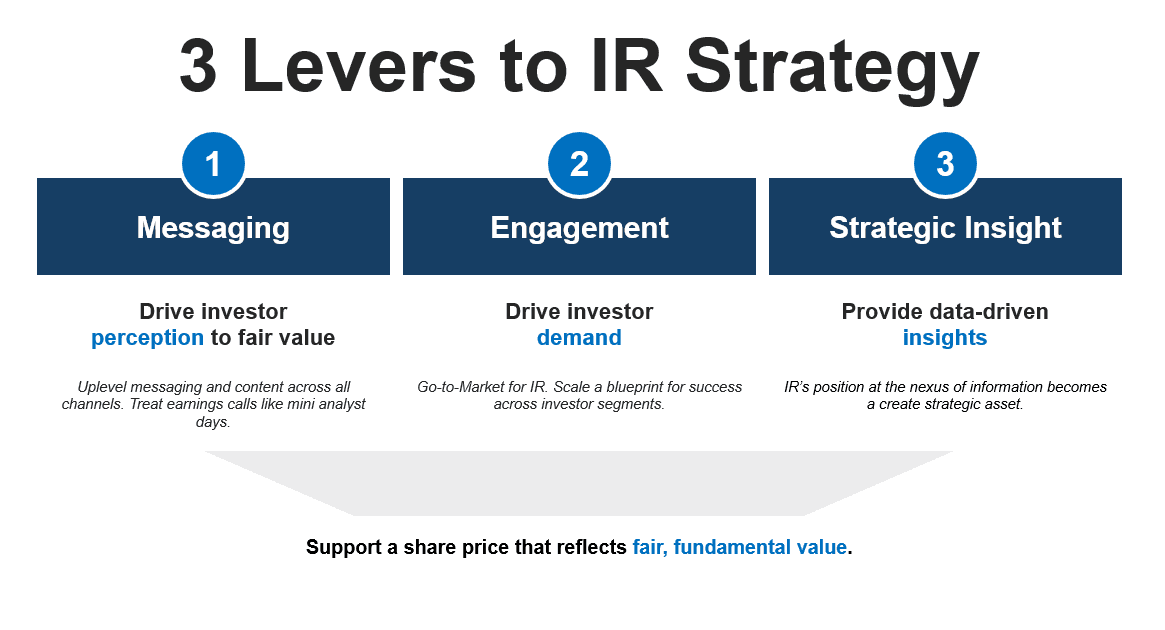
All of these are true in a limited sense, and they point to a broader goal - to support a share price that reflects fair, fundamental valuation.
Valuation matters: it shapes a company's cost of capital, its ability to compensate and retain employees, its reputation in the market, and the funding available to pursue growth. Achieving that goal is anything but simple.
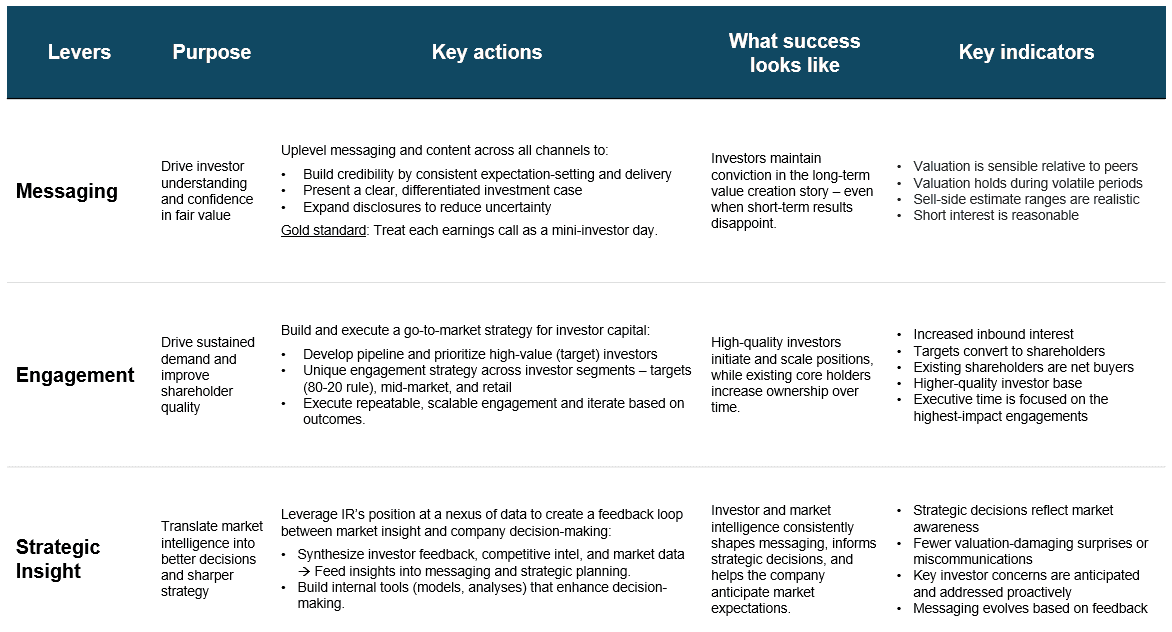
Over the course of my career in working on investor relations, I've developed an approach that has resonated with the executives that I have explained it to. It is built on three levers: messaging, engagement, and strategic insight. Each lever reinforces the others, and together they form a system that drives the high-level goal of investor relations: to support a share price that reflects fair, fundamental value.
Lever One: Messaging
Companies compete for investor capital against hundreds — often thousands — of alternative opportunities. Among these, investors gravitate towards investment opportunities with:
higher ROI,
lower uncertainty, and
a story that they can understand quickly and easily.
An effective IR function helps to move these variables in the right direction and thus make its company be seen as one of those opportunities — by educating the market, highlighting its differentiation, correcting misconceptions, and building the trust that earns a premium over time.
To achieve this, I believe in using a three-pronged approach to upleveling messaging and content across all channels - building credibility with the market, presenting a clear investment case, and enhancing financial disclosures and transparency.
Building credibility with the market
Fair valuation is, at its core, shaped by the stories that investors tell themselves and each other about a company. Each investor constructs a mental model about a company — what it does, its market opportunity, why it wins, and how much it's worth.
There are often many competing stories about a company being debated among investors (e.g., long vs. short). A company's leadership team and IR function — as insiders with a deep understanding of the business — has the right to influence that narrative towards a fair view of the business.
However, investors will generally be skeptical of the company's story and consider it to be the bull or upside scenario. This is based on a long history of management teams over-stating the company's potential. Nonetheless, management's story about the company is important to investors, and its weight depends on how much investors trust the management team.
Credibility is built through a simple but demanding process:
Setting the right expectations, including through measured/balanced tone and goal setting that makes management accountable. Quantifying is the gold standard, often through guidance and long-term targets.
Consistently and fairly measuring progress on goals.
Executing to meet expectations.
When the company does this consistently, quarter after quarter, it earns the trust that gives its version of the story more influence among competing stories circulating in the market.
Presenting a clear investment case
With credibility established, the company must articulate a compelling investment case that can win in the competition for investor capital. Management teams often have a sophisticated understanding of their business - they know most of the raw ingredients for a strong investment case. But management's knowledge can be lost in translation, when explaining it to the markets.
The key in writing a clear investment case for the market is to understand the perspective of investors and then bridge the gap. To do this, the company will need to:
Understand the investment case that aligns to fair value of the company,
Understand how investor perceptions differ from fair value (the perception gap),
Address investor's key concerns to narrow the perception gap (lowering investor uncertainty),
Differentiate the company from other options competing for the same capital by clearly communicating the company’s market opportunity, its competitive differentiation, its growth trajectory, and its path to profitability and free cash flow (showing investors the potential ROI), and
Simplify complexity to a clear framework for investors to understand how the business works, why it will win, and its value creation model (making it easier/faster for investors to understand).
It is tempting to treat this high salesmanship — after all, if management isn't excited about its opportunity, why would investors be? That's a fair point, and it is desirable for the company to be passionate advocates in explaining its story, vision, and strategy. However, a balanced and measured tone is important to maintain credibility and to make sure that the market doesn't get ahead of a fair valuation.
The key is to lead with real substance and data, which brings us to the next prong.
Enhancing disclosures and transparency
As each quarter goes by, new events with the company, the industry, and macroeconomic environment occur - the company releases new products, new competitors enter the space, inflation or interest rates rise, geopolitical events take place. With each event, investors then have to decide how this impacts the company and the investment case.
It's common for companies to treat earnings calls as a time to review the financial numbers, provide some commentary on their strategy or the industry, and then move on. For these companies, the market is left with their key concerns not answered and, instead, forms its own opinion on the company, resulting in the company ceding more control over its story in the market. It takes a large drop in the stock price or activist investors sending letters to the Board, in order for a company to wake up and begin telling its story more proactively.
As uncertainty goes up, for a company, its valuation multiple goes down. Investors dislike uncertainty, and a powerful lever that companies can pull is providing timely, accurate disclosures that reduce it.
I believe that each earnings call is an opportunity for the company to tell its story - show its differentiated investment case. The gold standard for an earnings call, in my view, is to treat each one like a smaller version of investor day.
Not in the sense of high salesmanship and grandiose presentations, but in providing the market with a mosaic of new financial disclosures/transparency that (1) shows that the company is moving in a positive direction toward the vision and strategic objectives that management has outlined, and (2) makes it easier for investors to build conviction in the investment case.
This doesn't mean oversharing or setting the wrong expectations. It means thoughtfully expanding the information set available to investors — new disclosures, clearer presentations, well-prepared Q&A — so they have what they need to address their key questions and value the company with confidence.
Lever Two: Engagement
At its root, a stock price is driven by supply and demand for its shares. With the value proposition established via messaging, it needs to reach investors effectively. I think of investor engagement as fundamentally analogous to building a go-to-market motion: build pipeline, identify high-value prospects, and execute on engagements.
Building pipeline, segmenting the market, and identifying target investors
In business, we think of market opportunity as the universe of potential customers. In building a pipeline for investor engagement, it is helpful to think in a similar way - identifying all potential funds that might invest in a company's stock and how much they might own.
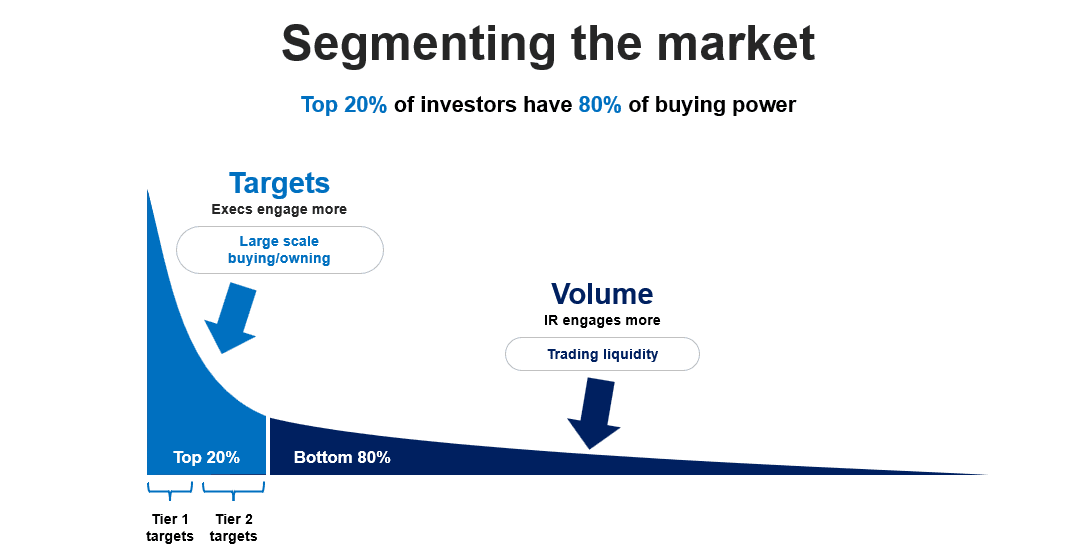
With that established, the market can segmented and an engagement approach determined for each segment to create a scalable system that drives demand across the entire addressable market for investor capital. Broadly speaking, there are three major segments in market: target investors (the highest value prospects), mid-market (other institutional investors), and retail investors.
Target investors
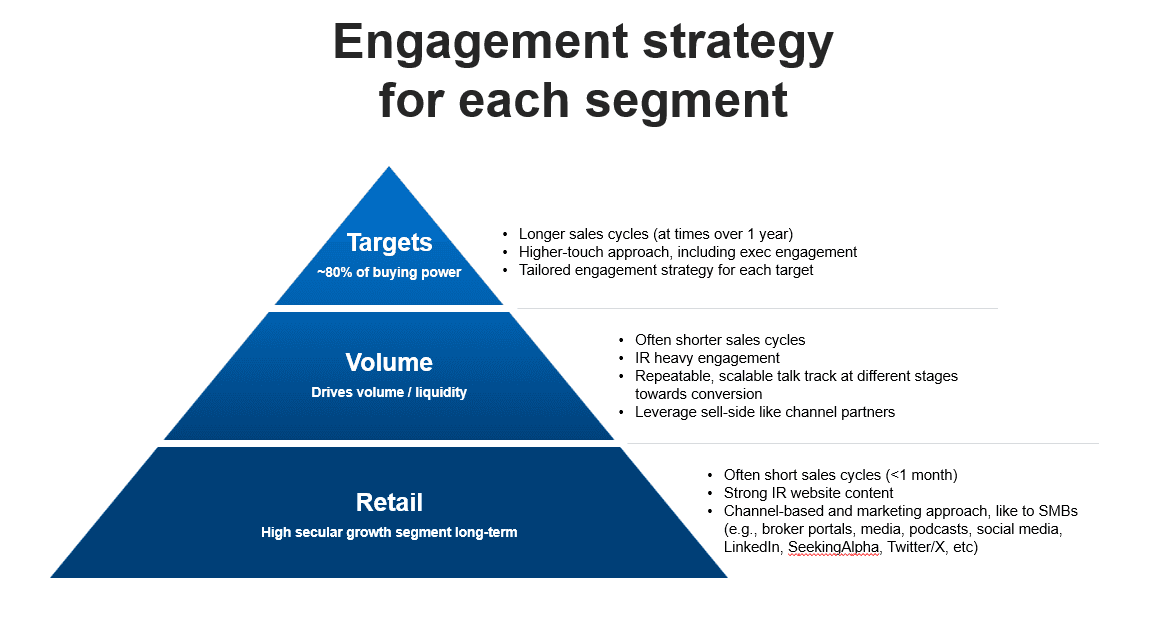
Investor buying power follows a 80/20 distribution. Roughly 20% of institutional firms control 80% of the buying power. This top 20% forms the target investor base. Within that base, you then identify the investors whose strategy, time horizon, and portfolio structure make them strong potential shareholders. This creates the target investor list - the high-conviction, high-buying power investors.
For target investors, direct engagement with IR builds the early relationship, and members of management come in at the later stages to help drive conversion to buying. Focusing executive time and relationship-building on that top tier of investors is how IR uses its most constrained resource — management's calendar — most effectively.
Mid-market
Below the top 20% of investors are the remaining institutional investors that make up a far smaller portion of buying power — mid-market. A scalable approach to engaging with mid-market is by leveraging the IR function and sell-side brokerages.
Sell-side brokers are analogous to channel partners and generally requires some level of support from the company, similar to channel partners. Their business model depends on producing research and hosting corporate access events, while the company's business model benefits from wider coverage and more investor engagement. This creates natural alignment as partners, and sell-side hosted events — such as conferences and group calls — are one scalable way to engage with mid-market and gain anonymous investor feedback, which can be used to refine messaging.
Beyond the sell-side channel, IR should drive direct engagement aggressively. Direct engagement, in general, drives increased interest in the company and incremental buying activity. My approach is to, whenever possible, take every investor's call — teaching, helping, and building enthusiasm for the company, regardless of firm size.
Retail
The last segment are retail investors, which includes anyone who chooses to research and trade stocks for their own account, rather than investing in a fund.
Research shows that this segment of the market is one of the fastest growing and it is expected to be significant in the future. They also have shorter investment cycles, buying in less than a month - whereas target investors can take, at times, a year or more.
However, this segment is one of the most challenging to engage with. Each individual's buying power is, typically, too small to justify a direct engagement with. To extend the go-to-market analogy, engaging with retail is more like marketing to SMBs or retail users.
An effective approach is to leverage multiple marketing channels. This includes the earnings call itself, podcasts, and social media. A well-made earnings call presentation, for example, will often find select slides from it being shared on X/Twitter, SeekingAlpha, or Reddit. Many companies will often have the CEO or CFO create a LinkedIn post that showcases earnings results, as well as doing interviews with TV media (e.g., CNBC, Wall Street Journal, Yahoo! Finance). In some cases, companies will have their CEO interview on podcasts such as Motley Fool.
Execute on engagement
Investor engagement, like sales and marketing, is a program. Just as a business often won't get a new customer purchase through one advertisement seen or one customer meeting, converting pipeline into investors takes consistent engagement.
Over time, consistent engagement creates momentum. Awareness leads to interest, interest leads to analysis, and analysis leads to investment. As the company engages targets consistently quarter after quarter, a portion of that pipeline converts to buyers, building a compounding momentum of demand.
The success of investor meetings, like customer meetings, depends on understanding the investor, presenting an investment thesis that aligns to their buying criteria, being well-prepared for Q&A, and following up after the meeting to answer any lingering questions or doubts. While target investors will warrant a customized presentation, for mid-market and retail, I believe it is better to create a repeatable talk-track and engagement process that can scale across the addressable market for investor capital.
Lever Three: Strategic Insight
In the course of doing IR work, the function becomes a natural nexus of information — investor feedback, peer earnings commentary, sell-side research, competitive moves, macro developments, etc. I view this data not as a byproduct, but as a strategic asset. Investor conversations, for example, frequently reveal important signals:
Concerns about the company’s strategy
Questions about competitive positioning
Areas where messaging may be unclear
Shifts in investor sentiment
The information stream that IR sees can then be channeled to productive uses.
First, IR can educate and communicate the company's story with increasing precision by synthesizing market feedback into its messaging.
Second, IR can advise the company on the shareholder perspective of value-creating activities, surface competitive intelligence, and channel investor feedback into valuable insights for the business. This elevates IR to a value-creating partner within the organization, which earns it the internal relationships and executive access that make everything else more effective.
Over time, this role can expand further. Building long-term, multi-scenario financial models. Evaluating revenue opportunities and unit economics. Contributing to internal TAM assessments. Collaborating on M&A evaluation.
This forms a feedback loop. The more value IR extracts from its data foundation, the faster the entire strategy compounds.
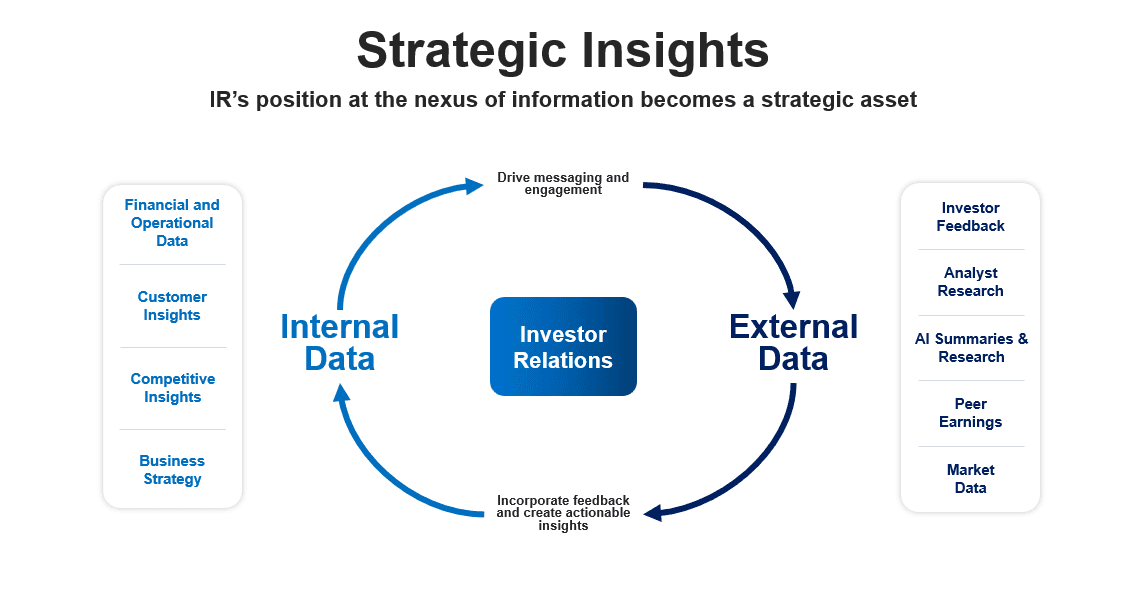
The Compounding Effect
What makes this framework powerful is not any one pillar in isolation — but the system it forms:
Messaging creates understanding —> Engagement converts understanding into ownership —>Strategic insight feeds learning back into the system.
Strong messaging feeds engagement by giving IR something compelling to sell. Broad engagement generates the feedback and market intelligence that sharpens messaging and fuels strategic insight. And strategic insight elevates IR from a communications function to a value-creating partner within the organization, which earns it the internal relationships and executive access that make everything else more effective.
Each quarter of consistent execution builds credibility. Each new external investor or analyst relationship expands reach. Each piece of investor feedback sharpens the story. Investor relations, done well, is a compounding function.
What Success Looks Like
One question I sometimes get is: how do you measure success of an effective IR function? If we go back to IR's goal — to support a share price that reflects fair, fundamental valuation — the measurement would, at first glance, be the stock price itself. However, a stock price of a company, and the reasons why any investor buys or sells a stock, is influenced by a wide range of factors, many of which out of the control of the company itself (e.g., macro-economic developments, investor withdrawals on their fund).
To understand success, we must look at factors underlying the stock price. Ultimately, the success of an IR program can be measured through market outcomes.
Messaging success is when investors view the company as a strong opportunity against the hundreds or thousands of competing alternatives available to them - and they maintain conviction in the long-term value creation story, even when short-term results disappoint. This means showing them an opportunity that is higher ROI, lower uncertainty, and presenting a story that they can understand quickly and easily. If the messaging strategy is working well, we should observe:
A valuation multiple that is sensible relative to peers and reflects a fair assessment of the company, given growth and profitability.
Valuation holds relative to peers, during times of volatility, while mispricings are smaller, shorter, and more quickly corrected.
Sell-side estimate ranges reflect a realistic understanding of the business.
Reasonable short interest relative to comparable companies.
For engagement, success is when high-quality investors initiate and scale positions, while existing core holders increase ownership over time. Measuring this is similar to how a company would typically measures its customer/sales engagement.
Increased inbound investor interest and meeting demand. (Signals pipeline health.)
Investor understanding is maturing and increasing in sophistication over subsequent conversations. (Signals pipeline health.)
Target investors convert from engagement to ownership. (Analog to new logo customers.)
Top shareholders are net buyers over time. (Analog to upselling existing customers.)
Shareholder pipeline of inbound interest and conversion shifts toward long-term, fundamental investors. (Analog to lower churn rate.)
Executive time is focused on the highest-impact engagements. (ROI internally.)
Strategic insight success is when investor and market intelligence consistently shapes messaging, informs strategic decisions, and helps the company anticipate market expectations. When this is done well, we should observe:
Strategic decisions reflect market awareness.
Fewer valuation-damaging surprises or miscommunications.
Key investor concerns are anticipated and addressed proactively
Messaging evolves based on real market feedback